

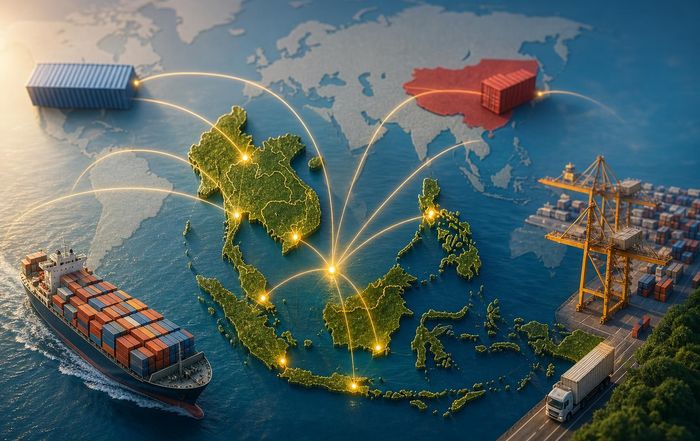
Trade Diversion Is Rewiring Global Supply Chains - And Southeast Asia Is One of the Biggest Winners
Trade flows that took decades to build are being re-drawn in a few short years. As tariffs, industrial policy, and geopolitical risk reshape global commerce, much of the world's manufacturing map is shifting away from a pure "China-centric" model toward a more distributed, "China-plus-one" or even "China-plus-many" structure. In that restructuring, Southeast Asia has emerged as one of the clearest beneficiaries.
For businesses, investors, and policymakers, the key question is no longer whether trade diversion is happening, but how durable it is - and how far Southeast Asian economies can turn short-term gains into long-term structural advantage.
How Trade Diversion Is Playing Out
Trade diversion occurs when goods are rerouted to avoid tariffs or other trade barriers, or when production itself relocates to new countries to sidestep costs and risks. The current wave is being driven by several overlapping forces.
The first is the tariff and technology confrontation between the United States and China. Since 2018, successive rounds of U.S. tariffs on Chinese goods, followed by Chinese counter-measures, have made direct China-U.S. trade more expensive and politically sensitive. The World Trade Organization has documented how these measures have altered global trade patterns, with third countries stepping in to fill gaps in U.S.-China flows. At the same time, new U.S. and European restrictions on advanced semiconductor and AI-related exports to China, alongside sanctions and investment screening, have pushed multinational manufacturers to reconsider where they assemble and source products.
Second, the pandemic exposed the fragility of highly concentrated supply chains. Lockdowns in Chinese industrial hubs, shipping bottlenecks, and component shortages convinced many companies that just-in-time systems built around a single dominant production base carried unacceptable risk. Institutions such as the International Monetary Fund and World Bank have repeatedly highlighted how "friend-shoring" and diversification are becoming mainstream corporate strategies rather than edge cases.
Third, governments are increasingly using industrial policy to attract strategic manufacturing. The U.S. CHIPS and Science Act, the Inflation Reduction Act, and EU green-industry subsidies are the most visible examples, but across Asia a quieter competition is under way as countries offer tax breaks, infrastructure, and regulatory reforms to lure investment out of China or to host "plus-one" capacity.
Southeast Asia sits at the intersection of these trends. With relatively low labor costs, improving infrastructure, a young workforce, and proximity to China's suppliers and markets, the region offers a politically safer and commercially viable alternative. For readers tracking global business, this is one of the most consequential structural shifts of the decade.
Where the Trade Is Going: Vietnam, Thailand, Malaysia, Indonesia and Beyond
Trade and investment data show that diversion is not a theoretical concept but a measurable shift. According to the UN Conference on Trade and Development at unctad.org, several Southeast Asian economies have seen outsized gains in exports and foreign direct investment in sectors directly affected by U.S.-China tensions.
Vietnam has become a key manufacturing hub for electronics, furniture, apparel, and consumer goods once made almost exclusively in China. Major companies such as Apple, Samsung, LG, and Foxconn have expanded assembly operations there, while suppliers in components and packaging are following. Vietnam's exports to the U.S. have grown sharply over the past decade, and the country has become one of America's largest import sources for categories like phones, computers, and furniture - many with deep supply-chain ties back into China.
Thailand and Malaysia have benefited in higher-value segments. Thailand has attracted automotive and electronics investment, including EV-related projects, while Malaysia is increasingly central to semiconductor assembly, testing, and packaging. The Semiconductor Industry Association at semiconductors.org notes that Malaysia already handles a significant share of global back-end chip manufacturing, and new projects are reinforcing that role as firms seek locations outside China.
Indonesia, with its vast nickel reserves, is emerging as a critical node in the global battery and EV supply chain. Government policies restricting raw ore exports have encouraged investment in smelting and downstream processing. While that strategy has sparked debate at institutions like the World Bank at worldbank.org, it has undeniably drawn billions of dollars in commitments from Chinese, Korean, and Western firms seeking secure access to battery materials.
Smaller economies are also carving out niches. Singapore remains a regional headquarters and logistics hub, hosting finance, legal, and data-center functions that support manufacturing across ASEAN. Philippines is attracting more electronics and BPO-linked manufacturing. Cambodia and Laos are seeing incremental growth in garments and light industry as suppliers look for even lower-cost locations connected to regional trade agreements.
For wise investors tracking markets and cross-border funding flows, these shifts are reshaping where capital, jobs, and export earnings are concentrated in Asia.
The China-Plus-One Strategy: Diversification, Not Full Decoupling
Despite political rhetoric about "decoupling," most multinationals are not abandoning China. Instead, they are adding capacity elsewhere to reduce exposure to tariffs, regulatory shocks, and supply disruptions. This "China-plus-one" or "China-plus-many" approach is central to understanding why Southeast Asia is gaining.
China remains deeply embedded in global value chains. It offers unmatched supplier density, sophisticated logistics, and a huge domestic market. Many goods exported from Vietnam, Malaysia, or Thailand still rely heavily on Chinese inputs. Trade statistics from bodies such as the OECD at oecd.org show that the value-added content of exports in Southeast Asia often includes significant imported intermediates from China, Japan, and Korea.
In practice, that means factories in Vietnam or Thailand may assemble products that are then shipped to the U.S. or Europe, while key components, machinery, and materials still originate in China. From a customs perspective, the final product is "Made in Vietnam" or "Made in Thailand," but the supply chain is transnational. This blurs the line between trade diversion and trade reconfiguration: some flows are simply being re-routed, but others are genuinely relocating stages of production.
For companies, the operational logic is straightforward. Setting up additional plants in Vietnam or Indonesia allows them to:
Maintain access to Chinese suppliers while avoiding some tariffs on finished goods.
Hedge against political and regulatory risk in any single jurisdiction.
Serve growing Southeast Asian consumer markets directly.
For regional governments, the challenge is to ensure that this trend leads to deeper industrial development rather than just tariff-arbitrage assembly operations.
Policy and Trade Agreements: ASEAN's Quiet Advantage
Southeast Asia's integration through ASEAN has given the region a structural advantage in the current environment. The ASEAN Free Trade Area and a web of bilateral and regional agreements have created a relatively open trading bloc that can plug into wider Asia-Pacific supply chains.
One of the most consequential frameworks is the Regional Comprehensive Economic Partnership (RCEP), which links ASEAN with China, Japan, South Korea, Australia, and New Zealand. By harmonizing rules of origin and reducing tariffs across a large group of economies, RCEP makes it easier for firms to design production networks that span multiple countries while still benefiting from preferential access. Official information from ASEAN at asean.org and RCEP members highlights how these rules are designed to encourage cross-border sourcing and assembly within the bloc.
At the same time, several Southeast Asian countries have negotiated their own agreements with major markets. Vietnam has a comprehensive trade deal with the European Union; Singapore and Vietnam are part of the Comprehensive and Progressive Agreement for Trans-Pacific Partnership (CPTPP); and others are exploring or deepening agreements with partners such as the U.S., the U.K., and regional neighbors. This dense network of accords gives multinational manufacturers more options to optimize tariff treatment and market access.
Domestic policies matter too. Vietnam, Indonesia, and Malaysia have offered tax incentives, special economic zones, and streamlined investment approvals to attract manufacturing. Thailand's Board of Investment has targeted high-tech and EV-related projects. These efforts complement broader reforms to improve the business environment, digital infrastructure, and logistics - all crucial to sustaining trade-driven growth.
Readers interested in how these dynamics intersect with global key economy trends and cross-border technology investment will find that Southeast Asia's policy choices are increasingly shaping regional competitiveness.
Sectoral Winners: Electronics, EVs, Textiles, and Beyond
Trade diversion is not evenly distributed across industries. Some sectors are seeing pronounced shifts into Southeast Asia, while others remain anchored in China or other established hubs.
Electronics and semiconductors are among the clearest winners. Firms such as Samsung, Intel, and Texas Instruments have expanded operations in Vietnam and Malaysia, leveraging local skills in assembly and testing. Malaysia, in particular, plays an outsized role in back-end chip manufacturing, while Vietnam has become central to smartphone and consumer-electronics assembly. As Western governments tighten export controls on advanced chips to China, companies are exploring how to position parts of their value chain in jurisdictions that face fewer restrictions, while still maintaining access to Asian suppliers.
The EV and battery ecosystem is another focal point. Indonesia's nickel-based strategy has drawn investment from Chinese, Korean, and Western automakers and battery firms. Thailand is positioning itself as a regional EV assembly hub, building on its long-standing role in conventional auto manufacturing. Malaysia and Vietnam are vying for roles in components, electronics, and supporting infrastructure. Policy documents from organizations like the International Energy Agency at iea.org underscore how critical Southeast Asia's minerals and manufacturing capacity could become in global decarbonization pathways.
Textiles, apparel, and footwear have seen production shift from China to Vietnam, Cambodia, and Indonesia, driven by labor-cost differentials and tariff considerations. However, these industries face rising scrutiny over labor conditions and environmental impact, especially from Western buyers and regulators, which may influence where and how future capacity is added.
Services linked to trade are also expanding. Logistics, warehousing, and digital platforms are growing alongside manufacturing. Singapore, as a global financial and logistics hub, continues to benefit from regional trade growth even when factories are located elsewhere. For businesses tracking jobs and skills, this services layer is as important as factory floors.
Risks and Frictions: Infrastructure, Governance, and Over-Concentration
While Southeast Asia's opportunity is substantial, assuming a smooth linear rise would be misleading. Several constraints could slow or complicate the region's ascent as a trade-diversion winner.
Infrastructure remains uneven. Ports, roads, rail links, and power supply vary widely in quality and reliability across and within countries. Congestion in major hubs, limited cold-chain capacity, and gaps in cross-border connectivity can erode some of the cost advantages that attract manufacturers in the first place. Development institutions such as the Asian Development Bank at adb.org estimate large infrastructure investment needs across ASEAN to sustain growth and integration.
Regulatory and governance challenges add another layer of friction. Differences in customs procedures, standards, and investment rules can create complexity for firms operating across multiple Southeast Asian markets. In some countries, concerns about legal predictability, corruption, or sudden policy shifts increase perceived risk. While reforms are under way, progress is uneven and can lag investor expectations.
Skills and productivity are also critical. Low wages alone are not enough to secure higher-value manufacturing. Countries that fail to invest in education, vocational training, and digital skills may find themselves stuck in low-margin assembly roles, vulnerable to automation or the next wave of relocation. Conversely, those that upgrade human capital can climb the value chain and capture more of the economic rents from trade diversion.
There are geopolitical risks as well. If Western governments suspect that some Southeast Asian exports are primarily conduits for Chinese goods that have undergone minimal transformation, they may respond with tighter rules of origin, anti-circumvention probes, or targeted tariffs. The U.S. Trade Representative at ustr.gov and the European Commission have both signaled closer scrutiny of such practices. That could create uncertainty for exporters whose business models rely heavily on tariff arbitrage rather than deeper local value-added.
Finally, environmental and social pressures are rising. Deforestation, carbon intensity, and labor standards are increasingly central to trade policy and corporate sourcing decisions. The EU's deforestation regulation and due-diligence rules, for example, could affect Southeast Asian exporters in agriculture, timber, and related sectors. Countries that fail to address these concerns may see some of their trade-diversion gains eroded by new non-tariff barriers.
What It Means for Businesses and Investors
For corporate decision-makers, the reconfiguration of trade offers both opportunity and complexity. Companies with heavy exposure to China as a manufacturing base or as a single market are under growing pressure - from boards, regulators, and customers - to diversify. Southeast Asia features prominently in those strategies, but success depends on careful execution.
Manufacturers need to assess not only labor costs but also supply-chain resilience, logistics, regulatory risk, and ESG factors in each potential location. In many cases, the optimal solution is a networked model: core components produced in one country, sub-assembly in another, final assembly in a third, with regional distribution hubs in places like Singapore. This demands sophisticated supply-chain management and real-time visibility, often underpinned by digital tools and AI-driven planning - areas covered regularly in our updated technology and AI sections.
Investors, meanwhile, are watching how trade diversion translates into earnings, valuations, and risk premia. Equity markets in Vietnam, Indonesia, and Thailand have already priced in some of the growth story, but the distribution of winners will likely be uneven, favoring firms with strong execution and local partnerships. Private equity and infrastructure funds are increasingly active in logistics, industrial parks, and renewable energy projects that underpin trade growth.
Banks and other financial intermediaries are adapting product offerings, from trade finance and supply-chain finance to currency-risk management and sustainability-linked loans. As more production moves into Southeast Asia, local-currency exposure, political risk insurance, and compliance with evolving sanctions and export-control regimes become more important.
For policymakers in other regions, the Southeast Asian experience offers lessons on how to attract diverted trade: credible reforms, infrastructure investment, and integration into regional trade architectures matter as much as headline incentives.
Can Southeast Asia Turn Trade Diversion into Durable Development?
The central question for the region is whether today's inflows of factories, capital, and trade can be converted into lasting development gains rather than a transient response to geopolitical shocks.
If Southeast Asian economies succeed in climbing the value chain, building domestic supplier bases, and strengthening institutions, they could emerge not just as alternative assembly sites, but as full-fledged industrial and innovation hubs. That would reinforce growth in global trade and deepen the region's role in everything from electronics and EVs to digital services and green technologies. It would also diversify the world's manufacturing footprint, potentially making the global economy more resilient to localized disruptions.
If they fall short - due to infrastructure bottlenecks, governance setbacks, skills gaps, or environmental and social backlash - some of the current momentum could stall. Firms might keep Southeast Asia as a marginal "plus-one" rather than a core pillar of their global operations, or they might shift future capacity to other emerging markets in South Asia, Latin America, or Africa.
For now, the balance of evidence suggests that Southeast Asia is one of the clearest beneficiaries of ongoing trade diversion. The region is not replacing China, but it is becoming an indispensable complement to it in the evolving architecture of global supply chains. How governments, businesses, and investors respond over the next few years will determine whether this window of opportunity becomes a new structural reality in the world economy.