

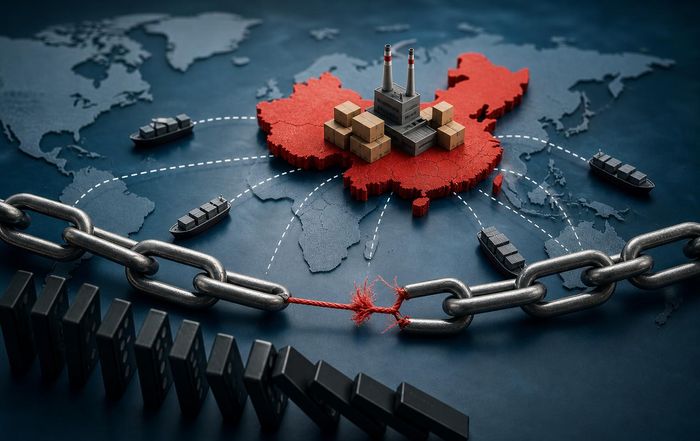
The Business Risks Behind Single-Country Supplier Dependence
For many global companies, concentrating sourcing in a single country once looked like a rational way to cut costs, simplify logistics, and scale quickly. Over the past decade, that calculation has changed dramatically. Trade wars, pandemic-era shutdowns, geopolitical tensions, and climate-related disruptions have exposed how fragile single-country supply strategies can be, even for otherwise well-managed businesses.
This page checks why dependence on one country for critical inputs has become a strategic risk, how that risk manifests across sectors and regions, and what practical steps boards and executives are taking to diversify and redesign supply chains.
How supply chains became so concentrated in single countries
From the late 1990s through the 2010s, a combination of trade liberalization, containerization, and digital coordination tools encouraged companies to consolidate production in lower-cost hubs. China, in particular, became the center of gravity for global manufacturing. According to the World Bank and OECD data, China's share of global manufacturing value added rose sharply over this period, while many advanced economies offshored labor-intensive and mid-tech production. Multinationals embraced just-in-time inventory models, lean manufacturing, and vendor consolidation, often using a single country to serve global demand in a product line. The logic was clear: scale brings purchasing power, lower unit costs, and easier oversight of a compact supplier base.
This model was reinforced by relatively stable geopolitics, low interest rates, and falling trade barriers under the World Trade Organization framework. For many executives, the primary supply-chain KPIs were cost, quality, and on-time delivery, not resilience. Risk management often focused on individual suppliers' financial health or operational reliability, rather than country-level exposure. The result was deep concentration: electronics assembled in one region, pharmaceuticals' active ingredients sourced from a handful of countries, and key minerals controlled by a small number of jurisdictions.
Over time, however, several structural forces began to erode the foundations of this model. Rising wages in traditional low-cost hubs, growing regulatory scrutiny, and environmental and social governance expectations made pure cost arbitrage less compelling. Trade tensions between the United States and China, Brexit-related frictions in Europe, and sanctions regimes added a political layer to what had been largely commercial decisions. When COVID-19 hit, shutdowns and border controls turned what had seemed like manageable theoretical risks into operational crises.
Why single-country dependence is now a strategic risk, not just an operational one
Dependence on a single country for critical inputs magnifies a wide spectrum of risks that can quickly move from operational inconvenience to existential business threats. At the highest level, these risks fall into five overlapping categories: geopolitical, regulatory, operational, financial, and reputational.
Geopolitical risk is the most visible. Trade disputes, sanctions, export controls, and diplomatic breakdowns can abruptly restrict access to suppliers or key technologies. The tightening of U.S. export controls on advanced semiconductors and manufacturing equipment to China, and reciprocal measures from Beijing, highlight how rapidly policy can reshape supply options. For companies reliant on components from one jurisdiction, such moves can disrupt entire product lines or force costly redesigns. Agencies such as the U.S. Department of Commerce and the European Commission have increasingly used trade and industrial policy tools, making country exposure a board-level issue rather than a procurement detail.
Regulatory risk has also grown. Governments are using industrial policy to encourage domestic production of strategic goods, from chips and batteries to pharmaceuticals. Initiatives such as the U.S. CHIPS and Science Act and the EU's Green Deal Industrial Plan are responses to perceived over-dependence on external suppliers. While these policies often come with subsidies or incentives, they also signal a shift away from laissez-faire globalization. Companies that ignore this shift may find themselves out of step with policymakers, facing tariffs, local-content requirements, or pressure to onshore key activities.
Operational risk is more immediate and frequently underestimated. Natural disasters, pandemics, power outages, and infrastructure failures can shut down entire industrial regions. The 2011 Tōhoku earthquake and tsunami in Japan, flooding in Thailand's industrial parks, and recent drought-related disruptions to hydropower and river transport in several regions have each exposed how a single-country concentration can paralyze global production. The World Economic Forum and insurers such as Allianz have repeatedly highlighted supply-chain disruption as a top global business risk, yet many companies still have limited visibility beyond their tier-1 suppliers.
Financial risk follows quickly. When a single-country supply chain breaks, companies face expedited shipping costs, spot-market pricing, production downtime, and lost sales. Balance sheets can be hit by inventory write-downs, penalties for missed deliveries, and the need to dual-source at higher prices. Credit rating agencies such as S&P Global and Moody's increasingly factor supply-chain resilience into their assessments, especially in sectors like automotive, electronics, and pharmaceuticals. For listed companies, analysts and investors now scrutinize country exposure in earnings calls and ESG reports, linking concentration risk directly to valuation.
Reputational risk is less obvious but increasingly important. Consumers and institutional investors are more attuned to where and how products are made. Heavy reliance on a single country with contested labor, environmental, or human-rights records can create brand vulnerability, especially when NGOs or media investigations highlight abuses. Regulations such as the German Supply Chain Due Diligence Act and the EU's Corporate Sustainability Due Diligence Directive, alongside modern slavery laws in the UK and Australia, push companies to demonstrate responsible sourcing. Over-concentration in a single jurisdiction can make it harder to meet these expectations and to pivot if problems emerge.
Sector snapshots: where single-country dependence bites hardest
The risks of single-country supplier dependence are not evenly distributed. Some industries face acute vulnerabilities due to technological complexity, regulatory constraints, or resource concentration. Three areas illustrate the challenge: semiconductors, pharmaceuticals, and critical minerals.
In semiconductors, manufacturing and advanced packaging are heavily concentrated in a small number of countries and firms. Taiwan, home to TSMC, and South Korea, home to Samsung Electronics, dominate leading-edge chip production. Many global tech and automotive companies effectively depend on fabrication capacity in one or two locations, even if their immediate suppliers are elsewhere. Geopolitical tensions in the Taiwan Strait, along with natural disaster risks, have prompted governments and major customers to push for geographic diversification, but building new fabs is capital-intensive and slow. Initiatives in the U.S., Europe, and Japan aim to localize more production, yet for now, dependence remains high.
The pharmaceutical sector faces a different but related problem. Active pharmaceutical ingredients (APIs) and key starting materials for many generic medicines are concentrated in a small number of manufacturing hubs, notably China and India. Reports from agencies such as the European Medicines Agency and the U.S. Food and Drug Administration have highlighted how this concentration contributes to recurring drug shortages. Compliance with stringent quality and regulatory standards makes it difficult to switch suppliers quickly, so when a single-country source encounters regulatory sanctions, contamination issues, or export restrictions, downstream shortages can last months or longer.
Critical minerals and clean-energy supply chains offer a third example. The International Energy Agency has documented how the production and processing of lithium, cobalt, rare earths, and other energy-transition minerals are dominated by a handful of countries. China, for instance, controls a large share of global rare earth processing and battery materials refining. As economies accelerate the shift to electric vehicles, renewable power, and energy storage, dependence on single-country suppliers for these inputs becomes both a climate and a security concern. Governments in the U.S., EU, Japan, and elsewhere are now funding alternative projects, but permitting, community opposition, and environmental constraints mean diversification will take time.
Other sectors are not immune. Automotive manufacturers that leaned heavily on single-country just-in-time sourcing for components like wiring harnesses or microcontrollers have experienced repeated production stoppages. Consumer electronics brands face reputational and operational exposure when a single manufacturing hub is hit by lockdowns or labor disputes. Even service-heavy sectors such as cloud computing can face concentration risk if they rely on data centers or contract developers located primarily in one jurisdiction.
The hidden layers: sub-tier suppliers and data concentration
One of the most challenging aspects of single-country dependence is that it often extends far beyond visible, tier-1 suppliers. Many companies have only partial insight into where their tier-2, tier-3, and upstream raw-material providers are located. A contract manufacturer may appear diversified on paper, with facilities in multiple countries, but rely on a single-country network for specialized components, tooling, or chemicals. When disruption hits that upstream network, the apparent geographic spread offers little protection.
This opacity is particularly problematic in complex, multi-step manufacturing such as electronics, aerospace, and biotech. Specialized inputs-photolithography equipment, advanced resins, specific catalysts, or niche machine tools-may be produced by only a handful of firms in one country. In some cases, intellectual property regimes and export controls intentionally limit where such equipment can be made or installed, creating structural dependence that cannot be solved quickly by switching vendors.
Data and digital infrastructure add another layer. Cloud services, software development, and IT operations are often concentrated in particular countries or regions for cost, talent, or regulatory reasons. While hyperscale cloud providers such as Amazon Web Services, Microsoft Azure, and Google Cloud operate globally, corporate policies may route workloads to specific regions, creating de facto concentration. Similarly, outsourcing large portions of software development or customer support to teams in one country exposes firms to local political instability, currency shocks, or regulatory changes affecting data flows and labor markets.
Cyber risk intersects with geography as well. Concentrating critical operations or suppliers in one jurisdiction can amplify exposure to localized cybercrime ecosystems or nation-state cyber operations. Agencies such as ENISA in Europe and CISA in the U.S. have warned that cyber incidents affecting industrial control systems, logistics platforms, or cloud services can cascade through global supply chains. When most of a company's critical vendors sit in one country, a targeted attack or systemic outage in that jurisdiction can have disproportionate impact.
Cost versus resilience: the new trade-offs for executives
For years, procurement and operations teams were rewarded for delivering cost savings and efficiency. Diversifying away from a highly optimized single-country supply base can look, at first glance, like a step backward: higher unit costs, duplicated tooling, more complex logistics, and greater management overhead. Yet the cumulative experience of trade disruptions, pandemic shocks, and climate events has changed how boards and investors think about these trade-offs.
Resilience is increasingly seen as a form of insurance and a competitive differentiator. Companies that could pivot production or switch suppliers during the pandemic often gained market share while less flexible rivals struggled. Analysts now ask not only "What is your cost base?" but "How quickly can you recover if this country shuts down or becomes inaccessible?" This shift is evident in corporate disclosures: more firms are including supply-chain risk and geographic concentration in their risk-factor sections and sustainability reports.
Still, diversification is not free. Establishing dual or multi-sourcing for critical components can require up-front investment in qualification, tooling, and regulatory approvals. Localizing production in higher-cost regions may compress margins, especially where customers resist price increases. Smaller firms, in particular, may lack the bargaining power to spread orders across multiple countries without losing volume discounts. For them, the question is not whether to diversify, but which parts of the supply chain justify the cost of redundancy.
Financial markets are also recalibrating. While investors have historically penalized higher operating expenses, there is growing recognition that overly fragile supply chains create tail risks that are difficult to model but highly damaging when realized. Asset managers integrating ESG and climate risk often view supply resilience as part of good governance. Credit insurers and trade-finance providers are likewise examining country concentration when pricing risk. The result is a more nuanced cost-resilience calculus, where modestly higher operating costs may be justified by lower probability of catastrophic disruption.
Emerging strategies to reduce single-country dependence
In response to these pressures, companies across industries are adopting a mix of structural and tactical strategies to reduce their exposure to any one country. The specifics vary by sector and firm size, but several themes are common.
First, many firms are moving from single-sourcing to dual or multi-sourcing for critical components and materials. Instead of relying on one supplier in one country, they qualify at least one alternative in a different jurisdiction, even if that second source initially receives a smaller share of volume. This approach is particularly common in automotive and electronics, where design and tooling costs are high but the cost of disruption is higher still. It often requires closer collaboration with engineering teams to design products that can accept components from multiple vendors.
Second, companies are rethinking their geographic footprint through strategies often described as "China+1," "nearshoring," or "friend-shoring." Rather than exiting major manufacturing hubs entirely, they add capacity in other countries that offer complementary advantages-such as Vietnam, Mexico, India, or Eastern European states-balancing cost, skills, and political alignment. Governments in North America and Europe are actively encouraging this through tax incentives, grants, and trade agreements, which firms weigh against infrastructure quality, regulatory stability, and labor availability.
Third, some businesses are redesigning products and processes to reduce dependence on specific inputs or technologies that are heavily concentrated in one country. This might involve substituting materials, simplifying component counts, or adopting more modular architectures that allow easier substitution of suppliers. In battery technology, for instance, researchers and companies are exploring chemistries that reduce reliance on cobalt, a mineral with concentrated production and governance challenges. In software, firms may adopt cloud-agnostic architectures to avoid over-dependence on a single provider's regional footprint.
Fourth, visibility and data are improving. Companies are investing in supply-chain mapping tools, control-tower platforms, and analytics to understand where their sub-tier suppliers are located and how disruptions propagate. Organizations such as the World Economic Forum and industry associations promote standardized frameworks for resilience assessment, while technology vendors offer increasingly sophisticated monitoring of geopolitical, climate, and cyber risks. With better data, firms can prioritize which single-country exposures are most critical and where mitigation will deliver the greatest risk reduction.
Finally, collaboration is becoming more common. In sectors where individual firms lack the scale to reshape supply chains alone-such as small medical-device manufacturers or mid-sized consumer brands-industry consortia and public-private partnerships are emerging to support shared infrastructure, pooled procurement, or joint investment in new facilities. Multilateral development banks and agencies like the International Finance Corporation and Asian Development Bank are financing projects that create alternative production hubs in developing economies, aligning corporate diversification needs with local development goals.
Governance, regulation, and the evolving role of the board
As supply-chain concentration risk moves from operational detail to strategic concern, corporate governance practices are adapting. Boards are increasingly expected to understand and oversee geographic exposure in the same way they oversee financial risk or cybersecurity. This shift is reinforced by regulators and standard-setters, which are asking for more transparency around supply chains and resilience planning.
In several jurisdictions, securities regulators and stock exchanges encourage or require listed companies to disclose material supply-chain risks, including geographic concentration, in their filings. Sustainability-reporting frameworks such as the Global Reporting Initiative and the emerging standards under the ISSB (International Sustainability Standards Board) are pushing companies to provide more structured information on supply resilience, climate-related supply risks, and human-rights due diligence. This, in turn, forces management teams to quantify their dependence on single-country suppliers and articulate mitigation strategies.
Boards are responding by integrating supply-chain resilience into risk committees' mandates, commissioning independent reviews, and asking for more granular dashboards. In some industries, directors with backgrounds in operations, logistics, or procurement are becoming more common, supplementing traditional finance and legal expertise. Internal audit functions are also expanding their scope to include assessments of supplier diversification, business continuity planning, and compliance with emerging due-diligence laws.
Regulators, for their part, face a balancing act. On one hand, they aim to reduce systemic vulnerabilities and strategic dependencies, especially in sectors such as healthcare, energy, and digital infrastructure. On the other, overly prescriptive localization mandates risk raising costs and fragmenting markets. Central banks and institutions like the IMF and OECD warn that excessive reshoring could dampen productivity and growth. Policymakers therefore tend to focus on a subset of "strategic" sectors while leaving most supply-chain diversification to market forces, albeit within a more politicized trade environment.
Practical questions executives should be asking
For leaders reviewing their exposure to single-country suppliers, the most useful starting point is a set of practical, quantitative questions rather than abstract concerns. Among them:
Which products or services drive the majority of revenue and margin, and what percentage of their critical inputs come from one country? How quickly could those inputs be replaced if that country became unavailable due to sanctions, conflict, or severe disruption?
What is the true geographic footprint of tier-2 and tier-3 suppliers for key components, and how reliable is the data underpinning that view? Are there "hidden monopolies" upstream-such as a single-country producer of a specialized chemical or machine tool-that could become bottlenecks?
How do country risk scores, as published by institutions like the World Bank, major insurers, or credit-rating agencies, align with actual exposure? Are there scenarios where a downgrade in a country's risk profile would trigger contractual issues, financing constraints, or insurance exclusions?
What is the governance structure for supply-chain risk? Does the board receive regular, comprehensible reporting on country concentration, and is this integrated into enterprise risk management alongside cyber, climate, and financial risks?
How do customers, regulators, and investors view the company's geographic footprint? Are there emerging expectations-for example, around domestic production of critical goods, or ethical sourcing-that make current single-country dependencies untenable over the medium term?
These questions do not yield simple answers, but they frame the trade-offs between cost, resilience, and strategic positioning in a way that aligns with broader corporate objectives.
A more distributed future-by design, not by accident
The era of frictionless globalization that encouraged deep single-country dependence is unlikely to return in its previous form. Geopolitical fragmentation, climate volatility, and rising scrutiny of supply-chain practices suggest that concentration risk will remain a central concern for executives, investors, and policymakers. Yet this does not mean a wholesale retreat from global integration. Instead, the emerging pattern is a more distributed, intentionally redundant network of suppliers and production sites.
For businesses, the challenge is to move from reactive crisis management-scrambling for alternatives when disruptions hit-to proactive design of resilient supply architectures. That involves hard choices: accepting some increase in cost and complexity, investing in better data and analytics, and engaging with governments and industry peers to shape the ecosystems in which they operate. It also requires a cultural shift, recognizing that efficiency and resilience are not mutually exclusive but must be balanced over time.
Companies that approach this deliberately-mapping their exposures, diversifying where it matters most, and embedding supply-chain thinking into strategy and governance-are likely to be better positioned in a world where shocks are more frequent and political fault lines more visible. Those that continue to rely heavily on single-country suppliers for critical inputs may enjoy short-term cost advantages, but they do so with a growing and increasingly visible risk premium attached.
For fans watching these trends, related content on global business, economy, and markets dynamics, as well as new events in technology and AI and global trade policy, will remain central to understanding how supply chains-and the risks behind single-country dependence-evolve in the years ahead.